

A clear aligner treatment plan may look clinically accurate on a digital setup, but its actual performance depends on how effectively the planned tooth movements are expressed in the patient’s mouth. One of the earliest indicators of a discrepancy between planned and achieved movement is an aligner that does not seat or fit as expected.
For orthodontists, identifying clear aligner fit issues is not simply about checking whether a tray appears loose. It requires evaluating aligner seating, attachment engagement, interproximal contacts, tooth movement, and the biological response to orthodontic forces.
An unnoticed fit discrepancy can affect subsequent aligner stages, compromise tracking, and increase the likelihood of refinements. Therefore, understanding how to manage clear aligner fit issues is essential for maintaining treatment control and clinical predictability.
What Are Clear Aligner Fit Issues?
Clear aligner fit issues occur when an appliance does not adapt accurately to the patient’s current dental anatomy or fails to engage the teeth as intended in the digital treatment plan.
Ideally, an aligner should demonstrate close adaptation around the clinical crowns, with appropriate engagement around attachments and no clinically significant gaps between the aligner and tooth surfaces.
However, discrepancies may develop when actual tooth movement does not match the programmed movement.
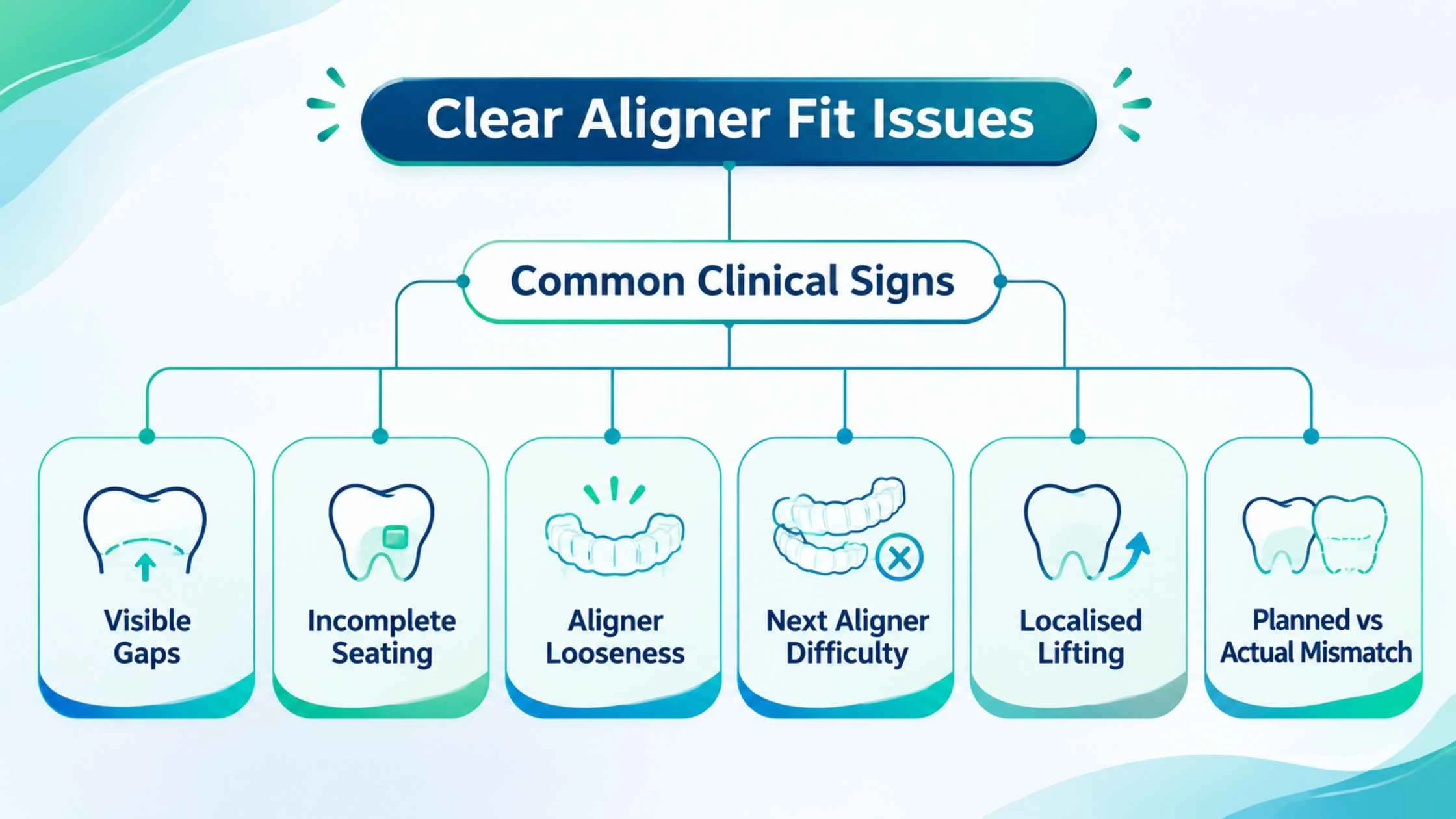
Common clinical signs include:
- Visible gaps between the aligner and incisal or occlusal surfaces.
- Incomplete seating around attachment areas.
- Loss of aligner retention or unexpected looseness.
- Difficulty seating the next aligner in the prescribed sequence.
- Localised lifting around individual teeth.
- Persistent discrepancies between planned and clinically achieved tooth positions.
These signs should be evaluated clinically rather than automatically attributed to poor patient compliance.
Why Do Clear Aligner Fit Problems Occur?
Several mechanical, biological, and treatment-related factors can contribute to aligner fit discrepancies. Understanding these causes is the first step towards effectively managing clear aligner fit issues during active treatment.
1. Incomplete Tooth Movement
Not every programmed movement is expressed with equal predictability. Rotation, extrusion, torque, and bodily movement may require additional biomechanical consideration.
When a tooth does not achieve its intended position, the subsequent aligner may fail to seat correctly.
An Indian clinical study by Izhar et al., published in 2019, compared digitally predicted and clinically achieved outcomes in 10 patients undergoing aligner treatment.
The study reported the following mean accuracy figures:
| Treatment stage | Mean accuracy |
| Stage T4 | 62.50% |
| Stage T6 | 68.83% |
| Stage T8 | 78.12% |
The findings demonstrated differences between predicted and achieved tooth positions, highlighting the importance of clinical monitoring. The study involved a small sample with mild-to-moderate lower anterior crowding, so these figures should not be generalised to all aligner cases.
Source: Comparative Assessment of Clinical and Predicted Treatment Outcomes – Indian clinical study.
2. Poor Attachment Engagement
Attachments help improve aligner retention and facilitate specific movements by influencing force application.
If an attachment is partially debonded, incorrectly positioned, or inadequately engaged, the aligner may not deliver the intended biomechanics.
Understanding the clinical applications of vertical and horizontal attachments can help orthodontists select appropriate attachment configurations during treatment planning.
3. Inadequate Interproximal Space
Insufficient space between adjacent teeth can restrict the planned movement, particularly during alignment and derotation.
If the required space has not been adequately created, the aligner may experience increased resistance during seating.
Orthodontists should evaluate the treatment plan and consider whether clinically indicated interproximal reduction (IPR) is required.
The decision should follow appropriate anatomical assessment and established clinical protocols. Evidence-based considerations for IPR in orthodontics are particularly relevant when managing space-related discrepancies.
4. Biological and Patient-Related Factors
Tooth movement depends on individual biological responses, periodontal support, bone characteristics, and the application of orthodontic forces.
Inconsistent aligner wear, premature progression to subsequent trays, and failure to follow the prescribed wear schedule may also contribute to tracking problems.
How to Identify Aligner Fit Issues During Clinical Evaluation
Early identification is essential to prevent minor discrepancies from developing into more complicated treatment challenges.
Orthodontists should incorporate the following checks during routine appointments.
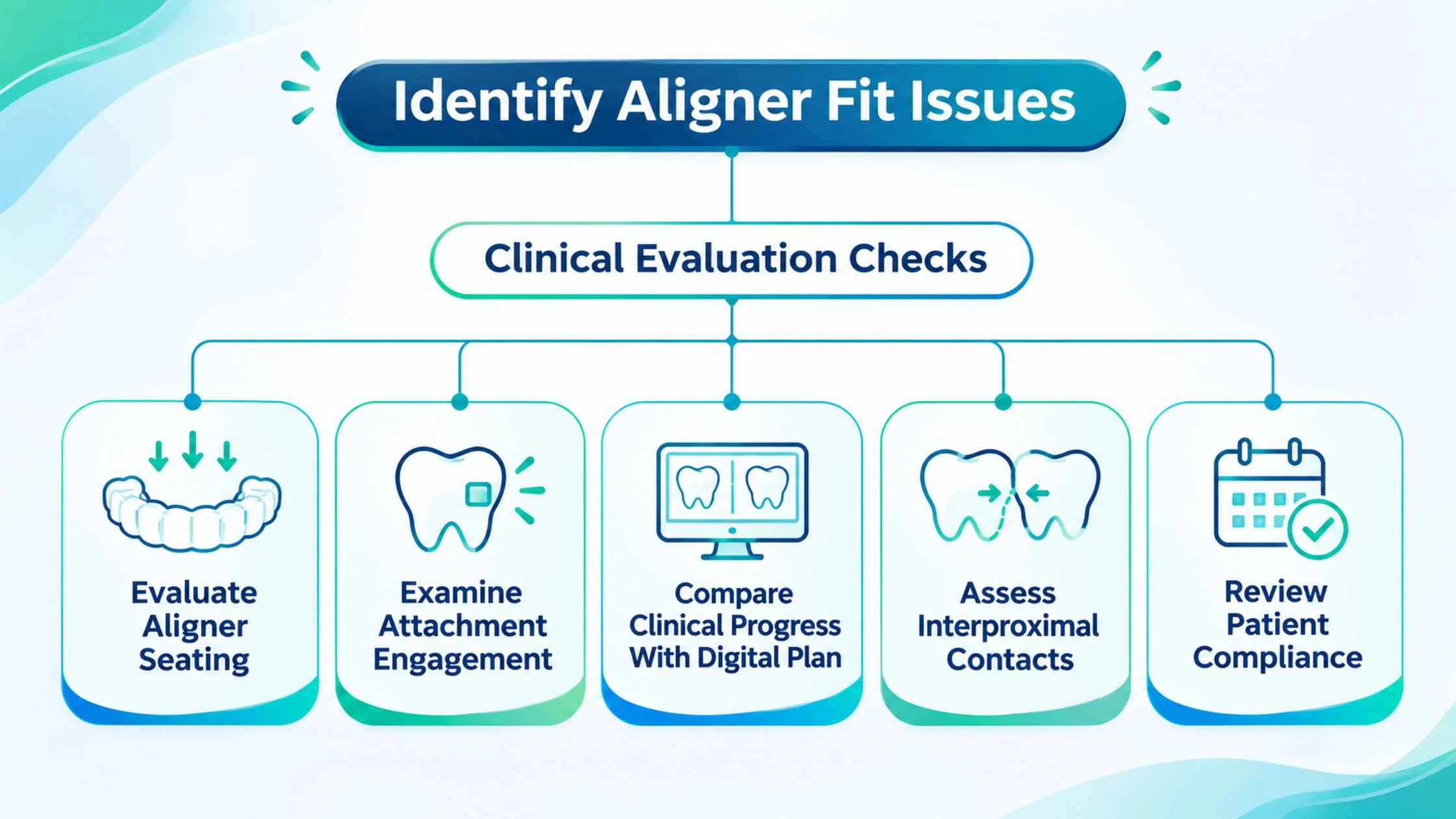
1. Evaluate Aligner Seating
Begin by examining the appliance from the incisal, occlusal, and buccal perspectives.
Look for visible gaps, particularly around teeth undergoing significant rotation, extrusion, or torque movements.
A small discrepancy may require observation, while persistent or increasing gaps warrant further investigation.
2. Examine Attachment Engagement
Check whether all planned attachments are present, intact, and adequately engaged by the aligner.
A missing or damaged attachment may explain why a particular tooth is not responding as expected.
3. Compare Clinical Progress With the Digital Setup
Review the current intraoral condition against the corresponding treatment stage.
Digital superimposition can help identify discrepancies in tooth position and determine whether the issue is localised or involves multiple teeth.
4. Assess Interproximal Contacts
Evaluate whether contact points are restricting the planned movement.
Where clinically indicated, reassess the space requirements before proceeding with further aligner stages.
5. Review Patient Compliance
Confirm the prescribed daily wear schedule, aligner change intervals, and seating technique.
Do not assume that every tracking issue is compliance-related. Mechanical and biological causes must also be considered.
How to Manage Clear Aligner Fit Issues: Clinical Management Approach
Once an aligner fit issue has been identified, management should depend on its location, severity, underlying cause, and effect on the treatment objective.
| Clinical finding | Recommended consideration |
| Minor localised gap | Check seating and monitor progress |
| Attachment disengagement | Assess attachment integrity and rebond if indicated |
| Persistent tracking loss | Reassess tooth position and treatment stage |
| Insufficient interproximal space | Evaluate clinically indicated IPR |
| Multiple teeth showing discrepancies | Consider rescanning and treatment replanning |
When Should Orthodontists Consider Refinement?
Refinement may be appropriate when the existing aligner sequence can no longer adequately address the discrepancy.
Before requesting refinement, evaluate:
- Current tooth positions against the digital setup.
- Remaining planned movements.
- Attachment condition and engagement.
- Available interproximal space.
- Occlusal relationships and periodontal considerations.
A new intraoral scan may be required to establish the actual clinical position of the teeth and develop an updated treatment plan.
Importantly, advancing through additional trays without resolving significant tracking discrepancies may compound the problem. A systematic approach to manage clear aligner fit issues can help orthodontists make better-informed decisions before proceeding with further stages.
Why Clinical Support Matters in Managing Fit Issues
Successful aligner treatment involves more than manufacturing a series of customised trays. Orthodontists need access to appropriate treatment planning, clinical guidance, and support when unexpected discrepancies arise.
This is where the clinical workflow behind an aligner system becomes important.
With Elencia Aligners, orthodontists can explore a treatment approach that combines orthodontist-led planning, clinical support, and structured treatment monitoring.
Understanding why clinical support matters when choosing a clear aligner system can help practitioners evaluate the importance of assistance throughout different treatment stages.
Additionally, understanding the relationship between pressure application and orthodontic tooth movement provides a stronger biomechanical foundation for assessing treatment progress.
Conclusion
Clear aligner fit issues should be treated as important clinical indicators rather than minor appliance-related inconveniences. Early identification, systematic assessment, and appropriate intervention can help orthodontists maintain better control over treatment progression and minimise avoidable refinements.
Ultimately, knowing how to manage clear aligner fit issues requires understanding the relationship between digital planning, biomechanics, clinical execution, and continuous monitoring. By combining these elements with appropriate clinical support, orthodontists can approach treatment challenges with greater confidence.
Elencia Aligners aims to support orthodontic professionals through orthodontist-led treatment planning, structured clinical workflows, and clinical assistance throughout the aligner treatment journey.
Frequently Asked Questions
1. What are the common signs of poor aligner fit?
Common signs include visible gaps between the aligner and teeth, incomplete attachment engagement, localised lifting, reduced retention, and difficulty seating subsequent trays.
2. Can patients continue wearing aligners if they are not fitting properly?
This depends on the clinical situation. Orthodontists should assess the discrepancy before advising whether to continue the current tray, modify the treatment sequence, or take further corrective action.
3. How can orthodontists prevent clear aligner tracking problems?
Appropriate case selection, accurate digital treatment planning, attachment placement, adequate space management, patient compliance monitoring, and regular clinical evaluations can help minimise tracking discrepancies.
4. When should an orthodontist recommend refinement aligners?
Refinement should be considered when clinically significant discrepancies remain and the existing aligner sequence cannot adequately achieve the intended treatment objectives.
5. Are aligner fit issues always caused by poor patient compliance?
No. Fit issues may result from biological variation, movement predictability, attachment problems, insufficient space, or treatment-planning limitations. A comprehensive clinical assessment is necessary to identify the underlying cause.