
Root Torque: The Biomechanical Basis of Controlled Root Movement
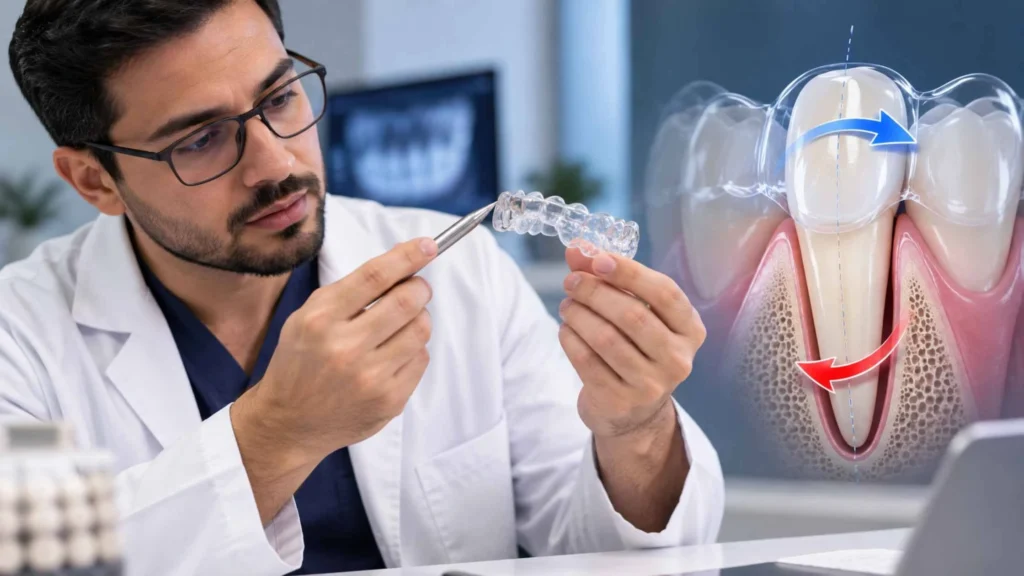
Root torque refers to the controlled buccolingual inclination of a tooth root, where the objective is to modify root position while maintaining appropriate control of the crown. In clear aligner treatment, achieving this movement requires a carefully designed force system rather than simply programming an angular change into the digital setup. Previous research published in the Journal of Contemporary Orthodontics highlights the importance of understanding biomechanical factors when planning and executing complex orthodontic tooth movements.
Why Root Torque Is Biomechanically Challenging
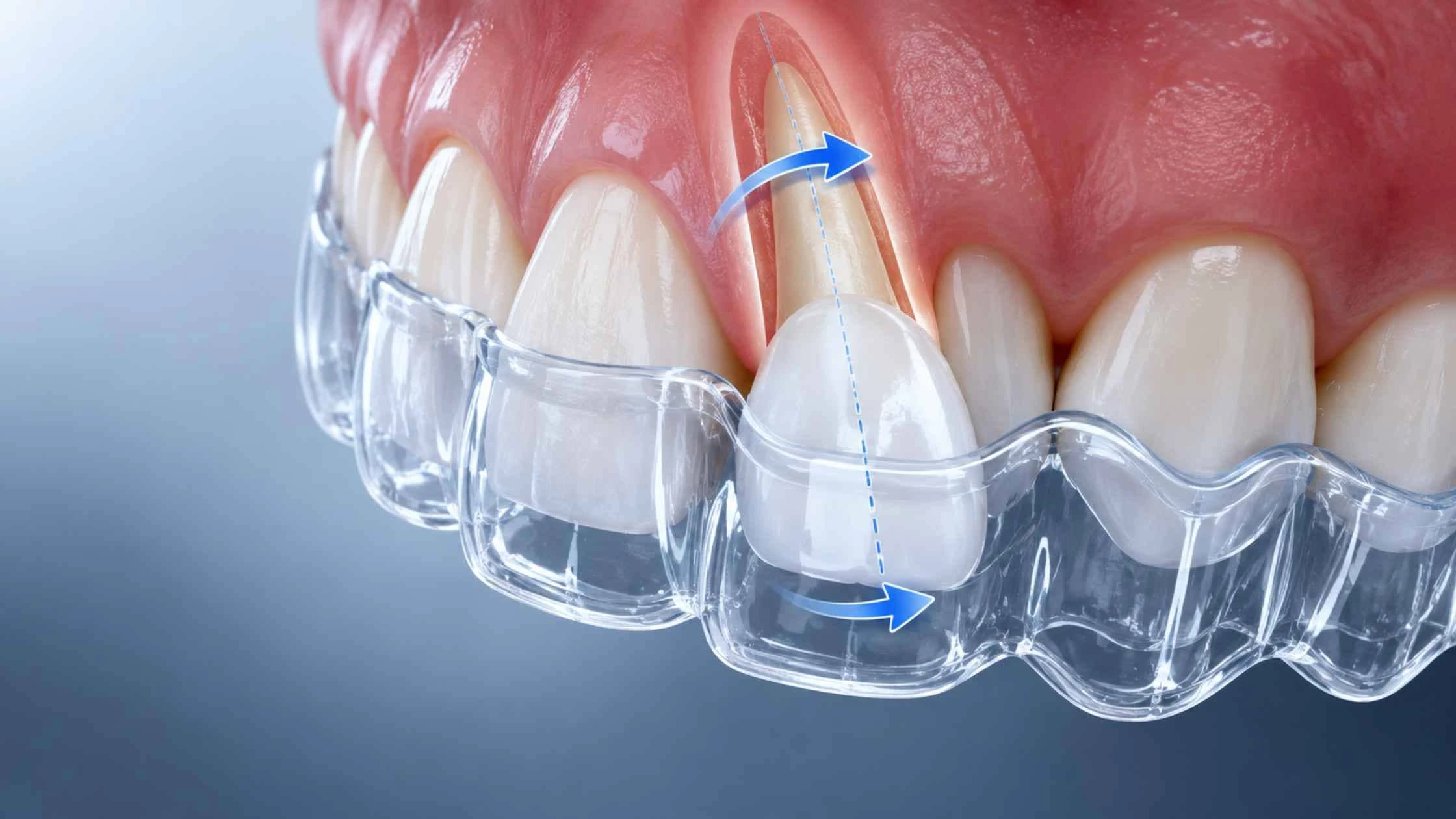
Root torque in clear aligners is challenging because the desired movement requires controlled force and a rotational moment rather than simple crown tipping. The aligner must maintain effective contact with the tooth and attachments while delivering sufficient force to influence the root position.
Thus, clear aligner biomechanics are strongly dependent on:
- Aligner material properties
- Thickness and stiffness
- Tooth morphology
- Contact area
- Attachment geometry
- Aligner seating
- Stage-to-stage activation
- Periodontal support
- Patient wear and compliance
- Position of adjacent teeth
Incisor Torque: Why the Anterior Segment Deserves Attention
Accurate torque planning is essential because small angular discrepancies can affect aesthetics, overbite, anterior guidance, and periodontal positioning. A digitally aligned crown does not guarantee correct root inclination. Clinicians should evaluate root control, attachment design, staging, and activation carefully, particularly in deep-bite correction, extraction cases, Class II camouflage, incisor proclination, periodontal-risk cases, and finishing.
What the Evidence Says About Predictability
The wider evidence base indicates caution in the interpretation of digital treatment simulations. In the most recent systematic review of clear aligner effectiveness, we concluded that many of the tooth movements considered could not be regarded as predictable enough to perform with a single series of aligners without additional intervention.
More recent evidence bolsters this idea. A systematic review of lower-incisor intrusion published in 2025 found predictability between 35% and 65%, with mean obtained intrusion reaching between 0.4 mm and 1.5 mm of invasion22. Attachments, elastics, refinement strategies, planned movement magnitude and patient-specific factors were also recognised as meaningful influences by the authors. While intrusion is not the same as torque, he said the results tell an important B2B tale: movement predictability should be judged by type of movement rather than generalized across all aligner movements as a property of the aligner system.
| Clinical movement | General planning consideration |
| Simple tipping | Often comparatively easier |
| Rotation | Tooth morphology and attachment design matter |
| Translation | Requires stronger three-dimensional control |
| Intrusion | Often less predictable |
| Extrusion | Requires effective retention and force expression |
| Torque | Requires controlled moment and root management |
This reinforces the need for treatment-planning protocols that distinguish between different biomechanical demands.
The Role of Clear Aligner Attachments
Clear aligner attachments remain some of the best tools available to optimize force application. Attachments change the shape of the tooth-aligner connection. Instead of letting the aligner of a relatively smooth crown, an attachment will form a more distinct surface against which the thermoplastic material has to engage. As for torque, it may improve the ability of your appliance to increase torque and control crown motion. Evidence for improved effectiveness of anterior root torque, rotation, mesiodistal movement and posterior anchorage from a systematic review examining composite attachments.
But, attachment selection should not be a checklist exercise. So does the shape, position, size, orientation and timing of activation. Theoretically perfect attachment can work differently when:
- The aligner is poorly seated
- The tooth has unusual morphology
- The attachment debonds
- The patient wears aligners inconsistently
- Adjacent teeth disrupt the desired force system
A review from 2025 also concluded that attachment morphology, number, and placement impacted movement efficiency and treatment predictability.
A Practical Biomechanical Model
An approach that helps evaluate torque (TW) especially for clinicians and aligner manufacturers is to consider the entire force pathway as follows:
Digital prescription
↓
Aligner geometry
↓
Attachment engagement
↓
Force + moment generation
↓
Tooth-periodontal response
↓
Clinical expression
↓
Scan/refinement feedback
And this is the model that shows why reforming just the digital prescription may fail to remedy a clinical predictability issue. If the amount of engagement with attachment, or if the aligner is not fully seated, then the programmed activation may never be expressed.
Root Movement With Clear Aligners: Key Clinical Variables
There are many variables that should be taken into consideration during the treatment planning.
Root Morphology
The mechanical response to an applied moment can be affected by root length, shape and position.
Crown Morphology
Activation of the aligner is through the crown. Thus, abnormal crown anatomy may influence force transfer also.
Attachment Design
With a purpose, you will see that this attachment can strengthen engagement but it also needs to be in the right place to achieve the anticipated movements.
Staging
Doing too much torque in one go may lower practical expression. An alternative may arise from smaller, controlled activations providing a more biomechanically manageable pathway.
Aligner Seating
No matter how well your appliance is, if it cannot seat properly, the full force system would not be operating.
Biological Response
Orthodontic movement is ultimately biological. Clinical outcome is affected by bone remodelling, the periodontal anatomy and individual variability.
Designing for Predictable Tooth Movement
Of course, predictable tooth movement should instead be a primary focus of S/W and manufacturing workflows, not just programming more torque. A practical approach includes:
- Assessing initial root inclination
- Defining the desired final position
- Distinguishing tipping from true torque
- Selecting suitable attachment geometry
- Staging movement progressively
Applying evidence-based overcorrection when appropriate When clinically indicated, follow-up through digital scans and radiographs. Modelling direction of the plan incorporating refinement when clinical movement is different from the simulation.Such a force-system based model can be utilized for bringing digital planning in closer concordance with clinical outcomes.
Digital Planning Should Be Biomechanically Informed
Modern aligner workflows offer sophisticated digital simulations, but visual accuracy does not always guarantee biomechanical accuracy. For B2B aligner stakeholders, the priority should be connecting digital planning, force systems, material behaviour, and measurable clinical outcomes rather than focusing on visual fidelity alone.
Digital motion → force pattern → material response → biological excitation/inhibition→ clinical benefit (measurable outcome).
Clinical Takeaway
Current evidence shows that root torque in clear aligners requires careful biomechanical planning rather than relying solely on digital prescriptions. Predictability depends on aligner design, material, attachments, staging, seating, compliance, and biological response, making continuous monitoring of planned versus achieved movement essential.
Digital simulation is not likely to be the sole determinant of the future life cycle of clear aligner treatment. Predictability will be increased through the integration of validated biomechanics, movement based staging, appropriate auxiliaries and objective clinical feedback into digital planning. Elencia Aligners supports orthodontic professionals with clinically guided planning, advanced 3D workflows, and treatment monitoring designed for controlled tooth movement. Looking for a B2B aligner partner for your practice? Contact Elencia Aligners to discuss your clinical requirements and partnership opportunities.
Frequently Asked Questions
Can root torque be predictably achieved with clear aligners?
Although the application of root torque with clear aligners is not as predictable as the control of simpler tooth movements, it can be done. The eventual outcomes rely upon the nature of attachment plan, phase, aligner seating, tooth healing mechanisms and material behavior during physiological loading and biological response. You may need to refine when planned and achieved positions do not align.
Do attachments improve torque control?
The presence of attachments may facilitate the aligner-tooth interaction and potentially improve expression of anterior root torque. Not to say their utility; it is determined by geometry, placement, engagement and treatment staging. As such, they should be chosen based on the anticipated force system as opposed to being added by rote.
How can clinicians monitor root movement during aligner therapy?
Clinicians can cross-compare planned digital positions with clinical scans, and when applicable radiographic assessments. Monitoring should be on tracking whether the actual crown and root positions track the prescription. When there are major variations, they may warrant stage change, extra auxiliaries or refinement aligners.