
For orthodontic professionals, understanding pressure on teeth during aligner treatment is important for planning predictable treatment. Clear aligners do not simply “push teeth into position.” They apply carefully directed forces to the crowns, creating a biological response involving the periodontal ligament (PDL), alveolar bone, tooth roots, and surrounding tissues. This response allows teeth to gradually change position.
For general dentists and orthodontists using digital treatment planning, this interaction sheds light on some of the inconsistency in movements among different cases (and why cases with greater predictability might require attachments, staging changes, overcorrection, or mechanics.
What Happens When an Aligner Applies Force?
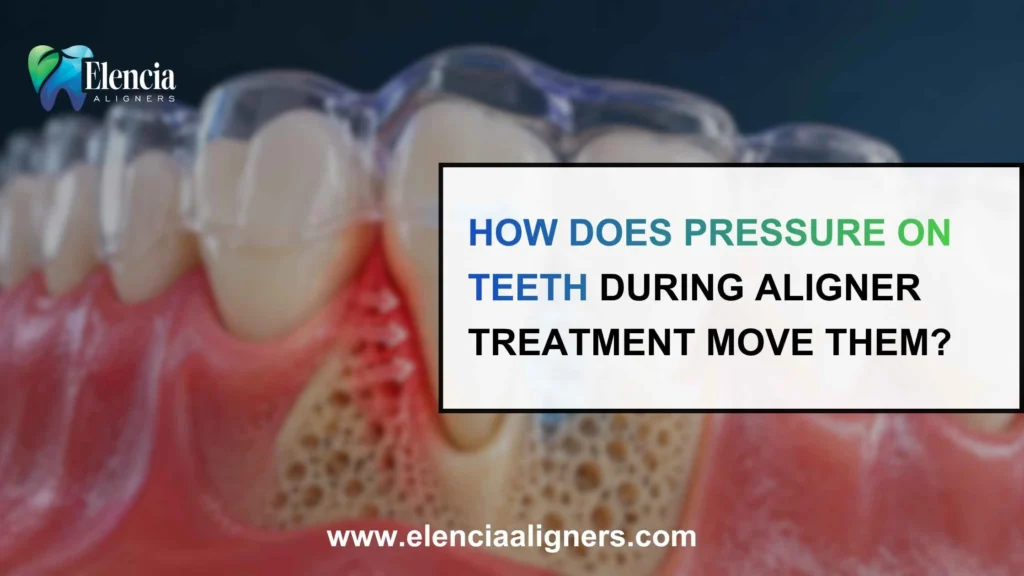
A tooth does not directly adhere to the underlying bone. Rather, the tooth is affixed within its alveolar socket via the periodontal ligament–a specialized form of connective tissue that can respond to mechanical stimulation. When a plastic aligner sits over a tooth, it contacts the crown at locations and to an extent determined by its programmed morphology. Such contacts create a system of forces that can cause tipping, rotation, extrusion, intrusion, translation, or torque.
Ortho-related tooth movements are local and biologically based changes in response to the delivery of mechanical force through integrin-mediated signaling at the level of the PDL and surrounding bone. The imbalance of compression and tension applied to the ligament triggers cellular and molecular responses for tissue remodeling.
A Simple Biomechanical View
| Stage | What Happens | Clinical Relevance |
| 1. Force application | The aligner contacts specific areas of the tooth | Creates the intended force system |
| 2. PDL response | Compression and tension develop | Mechanical stimulus reaches supporting tissues |
| 3. Cellular response | Biological signalling pathways are activated | Bone remodeling begins |
| 4. Bone adaptation | Resorption and formation occur | Space is created or maintained |
| 5. Tooth displacement | The tooth gradually changes position | Planned correction becomes clinically visible |
Therefore, pressure on teeth during aligner treatment should be understood as part of a larger mechanical and biological process rather than simple physical pushing.
Why Does Controlled Force Matter?
The idea is not to exert the most amount of force possible. Ideally, a controlled force system should create a suitable biological reaction, contributing to the maintenance of the condition of supporting periodontal tissues.
Loading that is either excessive or unevenly distributed may result in adverse tissue responses, whereas insufficient loading may fail to achieve the desired effect clinically. The response also changes with the kind of movement attempted and the unique biological milieu. For clinicians, this distinction becomes particularly relevant when planning:
- Root torque
- Bodily translation
- Rotation
- Extrusion
- Intrusion
- Arch expansion
- Mesialisation or distalisation
The effectiveness of an aligner depends partly on how accurately its geometry creates the intended force system.
Clear Aligner Biomechanics: More Than Crown Movement
Clear aligner biomechanics is the interaction between the aligner, tooth surface, periodontal ligaments (PDL), root position, attachments, material properties, and programmed movement sequence.
An aligner is mostly in contact with the visible part of the tooth that makes up the crown, but sometimes we want to displace or guide (but not fixate) the root as well. This presents a critical biomechanical challenge.
I mean, a fortune might go flop just as it would by merely tipping a crown, but the bodily translation does not happen. Similarly, while crown movement is a moment-to-force ratio for the IVDs that differs from upright pictures, alteration to the root inclination previously/horns mediastinum has changed another. The stress distribution around the crown, root, and PDL is afforded by finite element research, which elaborately displays how steerage in aligner design and auxiliaries can modify the mechanical space. This is why treatment planning must take into account the entire movement and not the eventual crown position only.
For complex cases, understanding how aligner design and force systems support challenging movements can help clinicians plan treatment more systematically. Learn more about how BioForce Aligners support complex orthodontic cases.
How Does Staging Influence Treatment?
A clear aligner treatment plan divides an overall correction into a sequence of smaller, planned movements. This sequencing allows the clinician and treatment software to determine which teeth should move, approximately how much they should move, and in what order.
This process is particularly important when multiple teeth require different types of correction at the same time.
A Typical Treatment Sequence
- Initial Position – Assess starting alignment and clinical conditions.
- Stage 1 – Begin the planned correction.
- Stage 2 – Continue progressive movement with appropriate force application.
- Stage 3 – Advance toward the planned intermediate position.
- Intermediate Correction – Review tracking and make necessary adjustments.
- Final Position – Reach the planned alignment and positioning.
Force application, anchorage needs, space management, and the neighbouring teeth relationship can be changed by altering the sequence of phases.
The staging of aligner therapy is highly related to treating difficult corrections in a variety of steps. Read more about the role of staging in aligner treatment planning and how sequencing fits into clinical planning.
What Clinicians Should Consider During Staging
- Which tooth should move first?
- Is sufficient space available for the intended correction?
- Are neighbouring teeth providing adequate anchorage?
- Does the planned movement require an attachment?
- Is root position being monitored rather than only crown position?
- Will the next stage build naturally on the previous one?
These considerations help translate a digital setup into a clinically meaningful treatment sequence.
Root Torque in Clear Aligner Treatment
One of the more demanding movements is root torque in clear aligner treatment. Torque attempts to change the inclination of the root while controlling the crown. Because aligners primarily engage external crown surfaces, generating the appropriate moment at the root can be challenging.
The difference between crown movement and root control is important:
Crown tipping
The crown changes position while the root responds differently.
Torque
The crown is controlled while the root inclination is deliberately altered.
When planning torque-intensive corrections, thus attachments, programmed overcorrection, sequencing and context may become relevant. Biomechanical investigations continue to point out sites where clear and advanced mechanisms may be required, for instance, torque control (or more complex movements) during the use of clear aligners. Because root control can be biomechanically demanding, clinicians should also consider the factors that influence predictability. Explore predictability of root torque in clear aligner treatment for further clinical considerations.
Pressure Does Not Mean the Tooth Is Being “Pushed Through Bone”
It is a common oversimplification that orthodontic appliances push teeth through bone. In reality, however, movement is mediated by biological remodeling of the surrounding tissues.
When a force is applied to the tooth, there will be compression on one side of the PDL and tension on another. These mechanobiological changes lead to cellular and molecular responses, which affect the local bone.
Hence, orthodontic tooth movement takes time and happens slowly rather than suddenly. This complicates treatment planning and emphasizes the importance of being biomechanically reasonable; that is, not pushing beyond biological limits.
Not every patient will have an equal biological response to a digitally prescribed movement. Clinical monitoring continues to be crucial during therapy.
How Attachments Help Direct Force
Attachments modify the interplay of an aligner with a tooth. This provides greater control than simply the clean surface finish of a smooth aligner-to-crown fit. An attachment adds geometry that can supply or react to directed forces and moments.
Attachments can help, depending on the clinical aim:
- Rotation
- Extrusion
- Intrusion
- Translation
- Torque control
- Anchorage management
Thus, their role should be regarded in the system as part of the whole force rather than as “grips” that improve the clenching of the transformed aligner. Aligner design research has also investigated features like trimline configuration and extensions, where design choices may impact mechanical performance.
What This Means for Dental Professionals
For dentists and orthodontists, pressure on teeth during aligner treatment should be considered alongside diagnosis, digital planning, attachments, sequencing, monitoring, and patient compliance.
A useful clinical framework is to consider three questions:
Where is the tooth now?
The starting position establishes the initial clinical and biomechanical problem.
Where should the tooth go?
The planned final position defines the treatment objective.
How should it get there?
The pathway depends on sequencing, force direction, attachments, root control, and clinical monitoring.
That third question is particularly important because two treatment plans may have the same final objective but use different mechanical pathways to reach it.
From Digital Planning to Clinical Execution
It is far more than the simple application of pressure to a crown; this is how pressure works in teeth during aligner treatment. Aligner shapes generate a force system, the PDL reacts to mechanical loading, cellular signalling induces bone remodelling, and the neighbouring tissues adapt over time. Understanding orthodontic tooth movement, force direction, attachments, and root control can help dental professionals sequence treatment more effectively. With Elencia Aligners, these clinical considerations can be integrated into digital planning and supported through systematic clinical monitoring, helping practitioners translate treatment objectives into a more structured aligner workflow.
FAQs About Pressure on Teeth During Aligner Treatment
Do aligners move teeth faster with more pressure?
Not necessarily. The treatment is only partially determined by both mechanical loading and biological response of the tissue. A higher force does not equal a faster correction and may lead to undesirable tissue effects. The goal is a suitable force system to emphasize the desired biological response.
When a tooth has just moved a tiny amount, why can an aligner feel quite tight?
An aligner may feel tight because it is pulling on a tooth to move into the desired programmed position. Feeling pressure does not imply that the target full correction has actually already occurred.
Why do not some of the teeth track with the aligner?
Movement complexity, attachment efficiency, amount of sequencing and throw-off, aligner seating, biologic response to the clear plastic appliance, and patient cooperation all confound tracking. Differences caused by a planned position where the surgeon positions it should be looked at clinically and not automatically blamed on a factor.
Is Root Movement More Challenging Than Crown Movement With Clear Aligners?
Torque and some other certain root movements can sometimes be more challenging, as the periodontium mainly receives activation at the crown. Root Control is a type of mechanics that may have a different proper order or attachment and could be required in addition to specific sequenced programmed mechanics.
How important is plastic staging while doing aligner treatment?
In aligner treatment, staging can determine the efficiency and predictability of treatment. An appropriate sequential movement will allow the clinician to more readily orchestrate space management, anchorage control, force direction, and tooth interaction.