

Clear aligner therapy has moved beyond straightforward alignment, with treatment planning now routinely addressing rotation, extrusion, torque, bodily movement, anchorage, and other complex mechanics. Within this evolution, Vertical vs Horizontal Attachments is an important consideration for clinicians and aligner manufacturers because attachment orientation changes how the aligner engages the tooth and expresses the programmed force system. For B2B stakeholders, the question is therefore not simply which attachment looks different, but which geometry is appropriate for a defined movement, tooth morphology, and staging strategy.
A 2026 scoping review published in Orthodontics & Craniofacial Research mapped the existing evidence on clear aligner attachments across 115 studies. The review found that 72.1% of the included studies were in vitro, with research mainly focusing on biomechanics, tooth movement, bonding, attachment materials, and aligner retention. The authors highlighted the need for more clinical, multicentre, and standardised research to establish the real-world effectiveness of attachment designs.
Why Attachment Geometry Matters in Aligner Biomechanics
When clear aligners contact tooth surfaces, they create orthodontic forces. Attachments provide more contact area and well-defined surfaces against which the aligner can engage the tooth, in addition to creating a cleat effect. Essentially, they are the physical mechanical connections between the digital treatment plan and the tooth. A systematic review stated that attachments can enhance anterior root torque, rotation, and mesiodistal movement while assisting posterior anchorage as well. However, that review also identified inconsistencies across studies and cautioned that characteristics related to shape, size, number and position may impact effectiveness.
This means that, as an aligner manufacturer, you should regard attachment libraries not simply as collections of pre-defined shapes. Their clinical utility is determined by the interaction of geometry with:
- The intended direction of movement
- Tooth anatomy
- Attachment position
- Aligner material properties
- Staging and activation
- Anchorage requirements
- Adjacent tooth contacts
- Patient-specific biomechanics
A simplified biomechanical model
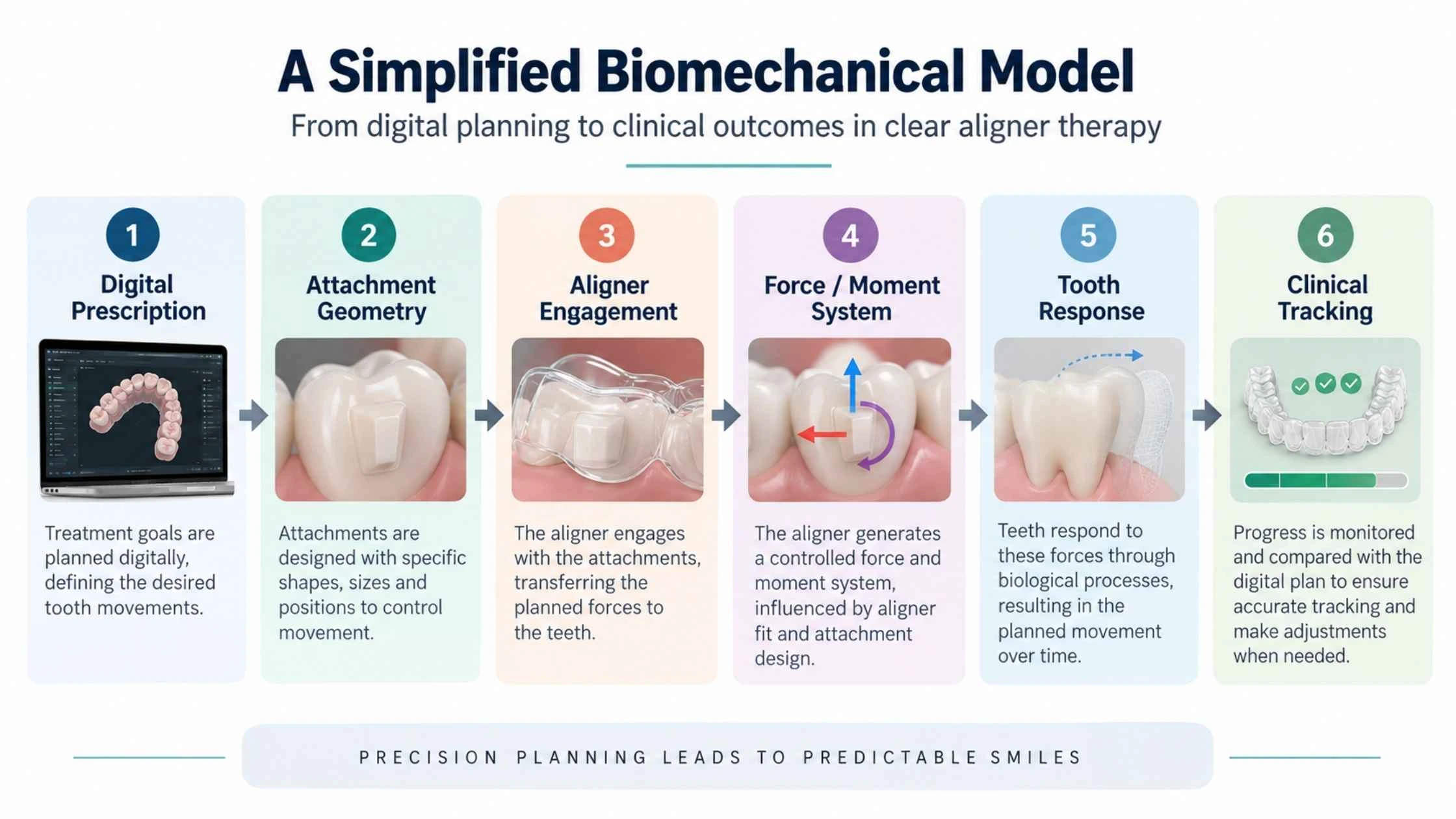
Digital prescription → Attachment geometry → Aligner engagement → Force/moment system → Tooth response → Clinical tracking
The attachment is therefore only one component of a larger mechanical system. A well-designed attachment cannot compensate for poor staging, inadequate retention, or an unrealistic movement prescription.
Vertical vs Horizontal Attachments: Understanding the Difference
In clear aligners, vertical attachments are primarily along the long axis of the tooth, and horizontal attachments extend more mesiodistally. Changing their orientation from the aforementioned increases or decreases the surface area available for engagement of an aligner and hence alters the force and moment systems produced during activation. Research evaluating alternate attachment configurations has demonstrated that tooth movement, aligner distortion, and periodontal ligament stress are influenced by the orientation of attachments. Horizontal rectangular attachments placed buccally and lingually produced significantly higher modelled tooth displacement compared to other attachment configurations in a finite-element study of premolar rotation.
However, this should not be interpreted as evidence that horizontal attachments are universally superior. The appropriate geometry depends on the movement being prescribed.
| Clinical consideration | Vertical rectangular attachment | Horizontal rectangular attachment |
| Primary design characteristic | Greater vertical dimension | Greater mesiodistal dimension |
| Common biomechanical role | Useful for engagement and rotational/angulation control | Useful where broader horizontal engagement is desirable |
| Rotation | Can provide effective rotational engagement, particularly on suitable tooth surfaces | Can also contribute substantially to rotational control depending on placement |
| Extrusion | May be selected depending on tooth and movement design | Evidence supports use in selected extrusion protocols. |
| Torque/control | May be incorporated into specific control strategies | Can provide useful force expression for certain torque movements |
| Key planning factor | Orientation relative to tooth axis | Orientation and active surface relative to movement |
| Clinical limitation | Effectiveness depends strongly on placement and tooth morphology. | Should not be selected solely because of its larger horizontal contact area |
The table should be interpreted as a planning framework rather than a universal prescription. Aligner attachment types must ultimately be selected according to the intended force system.
Vertical Attachments in Clear Aligners: Clinical Applications
The main benefit of a vertical design is a more exclusive vertical interface between the tooth and aligner. When rotation or angulation is necessary, it can perform this function well. Since rounder teeth would give relatively small surfaces for the aligner to hold on to, rotational correction can be especially important. Attachments enhance the mechanical interlocking available to the aligner. This recent finite-element study comparing possible vertical and horizontal rectangular attachments for premolar rotation indicated that attachment-assisted configurations provided superior retention; however,, the data also demonstrated significant modelled tooth displacement with the tested conditions using horizontal rectangular attachments.
Other studies have respectively engaged in mesiodistal angulation and rotation of vertical rectangular attachments. Mander published a study of maxillary anterior teeth, where they found that the accuracy for mesiodistal angulation was greater for vestibulolingual inclination in the laterals with conventional vertical attachments, and vice versa with horizontal attachment. It exemplifies a key B2B dogma: attachment geometry ought to be movement-type, not product-label-specific.
Horizontal Attachments in Clear Aligners: Clinical Applications
Horizontal attachments with clear aligners increase the mesiodistal contact area. They are often tested in movements where vertical force has to be controlled more precisely or in a greater bandwidth. For the extrusion range of 0.3–2.5 mm that they tested, the investigators estimated that horizontal attachments provided about 22% more efficient coverage compared to an optimised design. Importantly, this finding should not be extrapolated to all teeth/movements. The trial focused on a particular clinical scenario: furcation exploration of maxillary lateral incisor (LI) extrusion. This is an important difference for manufacturers in creating treatment protocols. This must correlate to the tooth, movement, attachment geometry, and clinical conditions in which it was produced.
What Does the Evidence Say About Attachment Selection?
Contemporary evidence supports the clinical importance of such attachments but not a universal attachment architecture.
Evolutionarily, a more recent complete review in 2025 demonstrated that the shape, number, and position of the attachment can impact how efficiently an organism moves into, maintains itself within its host cells, and its ability to mount a successful treatment. Furthermore, it stressed the importance of customised planning and mentioned that optimised attachment designs do not nearly always show statistically significant superiority over conventional designs across all movements. In another study, a systematic review on composite attachments similarly indicated that orthodontic movement expression can be improved with the use of attachments but such findings were heterogeneous across the limited clinical data available. What might this mean for aligner manufacturers? It suggests that digital treatment software should enable clinicians to assess attachment selection in conjunction with movement mechanics rather than treating the choice of attachments as a separate design step.
Clinical Decision Framework for B2B Treatment Planning
A practical attachment-selection workflow can be structured as follows:
Define the movement.
Specifically, see if this prescription is on the line of rotation or other EG: extrusion, intrusion, torque, tipping, or translation.
Assess tooth morphology.
Assess whether there are enough cohesive surfaces on the tooth for the aligner to engage.
Select attachment orientation.
Compare verticals, horizontals, optimised, or other geometries according to the force system
Determine position and dimensions.
Okay, having an attachment point may be even more important than the shape of your attachment. The mechanics are also influenced by the distance between the position where these forces are applied and the tooth centre of resistance, illustrating that they can be used effectively to alter tooth position.
Evaluate anchorage.
Reciprocal anchorage may entail attachments on adjacent teeth when complex movements are involved.
Validate digitally and clinically
Before completing the prescription, review predicted motion, staging and the seating of your aligners and what tracking you can expect.
The rationale for this is consistent with current-day biomechanical thinking: that it would be ineffective to merely increase the surface area for attachment, but rather to create an adequate and clinically meaningful mechanical force system.
Implications for Aligner Manufacturers and Orthodontic Laboratories
For B2B aligner production, attachment planning has implications across the complete workflow.
Treatment-planning software
Attachment selection should be linked to movement goals, tooth type and staging rather than being based solely on generic presets.
Manufacturing accuracy
You need to reproduce attachment geometry consistently in the aligner. Low reproduction or limited seating around an attachment can lessen the desirable mechanical interface.
Clinical documentation
Manufacturers should ensure that when describing the application of various orthodontic attachments, they are clear; laboratory results should not be presented as universal clinical guarantees.
Quality control
Attachment-related workflows should consider:
- Template accuracy
- Attachment geometry
- Aligner fit
- Material consistency
- Seating around attachment surfaces
- Stage-to-stage force requirements
- Clinical tracking feedback
A robust research base also advocates the data-driven approach. The 2026 scoping review showed that whilst there has been considerable expansion of research in this area since the year 2020, clinical evidence is still less developed than laboratory evidence. [1] This opens the door for manufacturers to submit higher-quality clinical data instead of limited finite-element or bench testing.
A More Useful Way to Compare Attachments
The debate over vertical vs horizontal attachments becomes more meaningful when the question changes from “Which attachment is better?” to:
“Which attachment creates the most appropriate mechanical interface for this specific movement?”
Vertical and horizontal configurations should therefore be viewed as tools within a broader biomechanical system. Tooth anatomy, attachment position, aligner design, staging, material properties, and anchorage all influence the final clinical result. For B2B aligner companies, this perspective can support more evidence-based treatment protocols, better software logic, and more transparent communication with orthodontic professionals.
Clinical Validation: The Next Step in Attachment Design
Avoid viewing vertical vs horizontal attachments as two universal solutions that seem to be competing with each other. Since they change how each geometry modifies aligner-tooth engagement and contribute to a specific FSMS, their clinical significance is multifold. The current research emphasises the importance of clear aligner attachments but shows evidence to be movement-specific and, in many cases, laboratory-based. This means that for day-one clinical practice, B2B aligner manufacturers should not only build more attachments at a greater scale but also actually connect crown & root design to clinically validated protocols combined with digital treatment planning and validated treatment outcomes.
An attachment strategy, informed by the clinic, can facilitate movement in a situation where there is an inherent discrepancy between labelled movement and actual expression, one of the most difficult obstacles in contemporary aligner biomechanics. The future of clear aligner therapy will depend not only on better attachment designs but also on how effectively those designs are incorporated into digital planning, staging, manufacturing, and clinical monitoring. For orthodontists and aligner providers, collaboration with an experienced aligner partner can help translate biomechanical principles into repeatable clinical workflows. To discuss professional collaboration or aligner case-planning requirements, contact Elencia Aligners.
FAQs
Should you go vertical or horizontal?
Not universally. Some geometries, therefore, may not make sense for certain movements based on the available evidence. Horizontal configurations cleared quite well in a number of programmes/extrusion and torque applications. Potentially, U can prove handy in many vertical cases for rotation and angulation control strategies. Selection should remain case-specific.
In which cases are horizontal attachments in clear aligners usually given?
They might be used when a more general mesiodistal involvement or specific force direction is wanted. Such studies have shown clinical evidence of their effectiveness in staging protocols for a limited number of teeth, although outcomes should not necessarily be extrapolated to other movements or teeth.
Do clear aligner attachments ensure movement of teeth as planned?
No way: Attachments do help with mechanical engagement but alone do not ensure a programmed movement will occur. Staging, aligner fit, material properties, tooth morphology, biological response, and patient compliance can also determine clinical expression.
What factors should aligner manufacturers keep in mind whilst developing their attachment libraries?
Manufacturers must consider movement-specific evidence and integrate attachment geometry, tooth morphology, placement, aligner-material behaviour, staging, and clinical validation. More great are libraries based on documented biomechanical rationale as opposed to many shapes without definitions of indications.