

Why One Clinic Quotes ₹50,000 While Another Charges ₹3 Lakh+
If you’ve visited multiple clinics for clear aligners, you’ve probably noticed something surprising—prices can vary dramatically. One clinic may quote ₹50,000, another ₹1.5 lakh, while global brands may cost over ₹3 lakh.
So why such a huge difference? The answer isn’t just the brand name. The cost of clear aligners depends on how your treatment is planned, monitored, and priced. Here’s what actually drives the number on your quote—and how to choose the right treatment for your smile.
Understanding the Clear Aligners Cost in India can help you compare different treatment options and understand what you are actually paying fo
What Determines the Clear Aligners Cost in India?
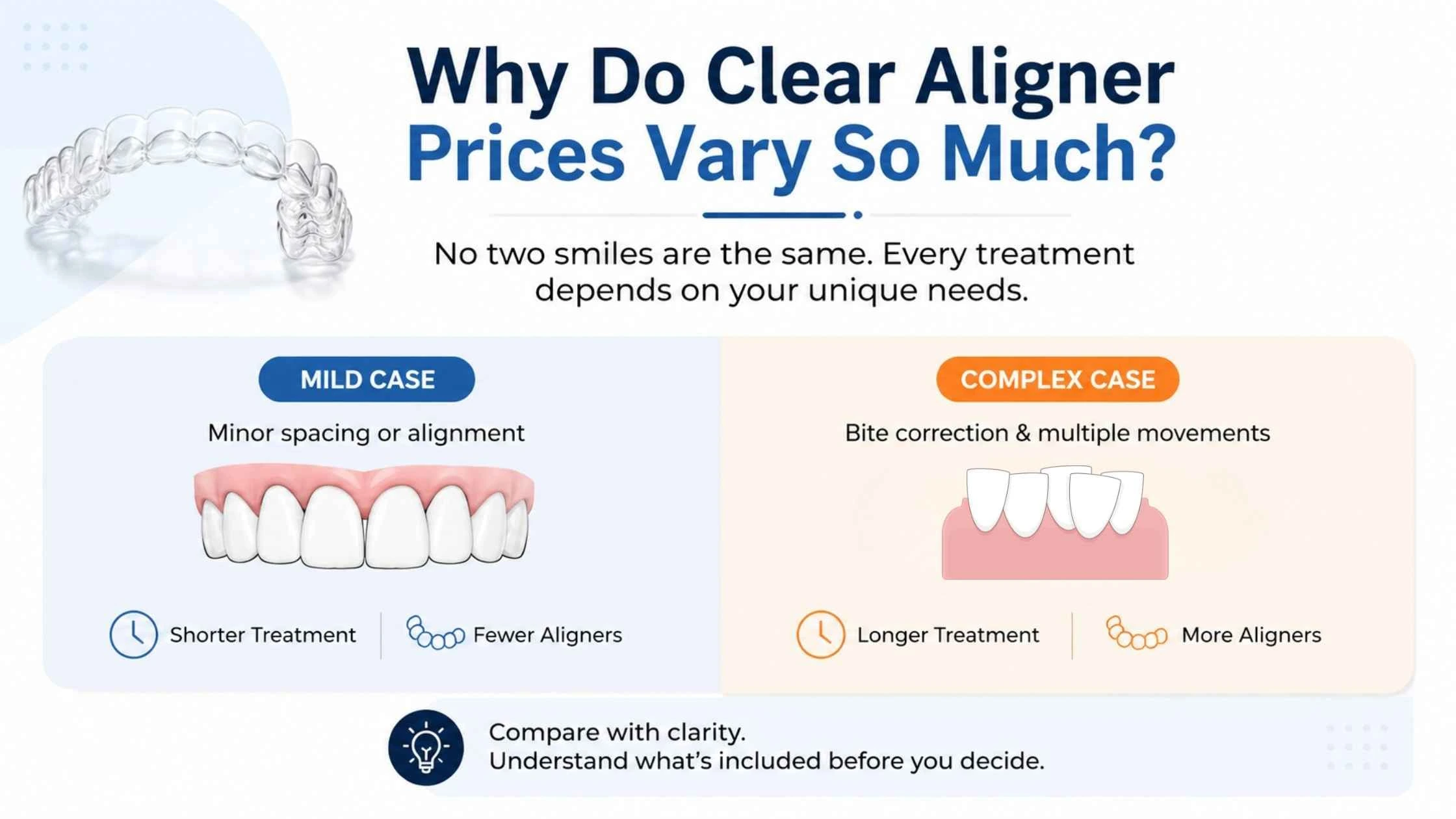
Five factors shape what you’ll pay for clear aligner treatment in India:
- Case complexity – More complex misalignments require more aligners and a longer treatment timeline.
- Orthodontist expertise – Accurate diagnosis and treatment planning are essential for predictable results.
- Aligner technology – Material quality, digital planning software, and manufacturing precision all influence outcomes.
- Manufacturing & logistics – Imported systems generally cost more because of international manufacturing and distribution.
- Pricing model – Some brands charge a fixed treatment package, while others charge only for the aligners actually required.
That last point is often overlooked, but it can significantly affect your final treatment cost.
Types of Clear Aligners Available in India
Not all clear aligners are the same․ The Indian market is classified broadly into four types․
1․ Globally Recognized Clear Aligner Systems
Global brands such as Invisalign‚ ClearCorrect and Spark have amassed decades of experience‚ innovation‚ and clinical research․ Their system is the most expensive because of its international manufacturing‚ complexity of digital workflows‚ supporting infrastructure and global brand recognition․
2․ Premium Indo-Spanish orthodontist-led clear aligner system
Elencia follows a different approach to clear aligner therapy‚ combining European digital orthodontics‚ BioForce™ technology and Indian clinical experience‚ an Indo-Spanish invention that is bespoke to the patient and orthodontist led․
All treatments are planned‚ prescribed‚ treated in accordance with digital workflows‚ scheduled superimpositions and standardized refinement protocols and provided exclusively by licensed dentists․ All cases are clinically supervised by a doctor during all their treatment and follow-ups․
Instead‚ Elencia uses an open per-aligner pricing system where patients pay only for the number of aligners they will need in their particular treatment plan․
3․ Conventional Indian Aligner Brands
Several Indian companies offer clear aligners at affordable rates․ While they are suitable for simple cases‚ they differ in:
- Treatment planning protocols
- Orthodontist involvement
- Aligner material
- Refinement policies
- Digital workflow
- Long-term clinical support
Remember that the evidence base behind the treatment is as important as the quoted cost of the provider․
4. Direct-to-Consumer (D2C) or At-Home Aligners
Usually the least expensive option, often priced between ₹40,000 and ₹60,000. Many rely primarily on remote monitoring with limited in-person orthodontic supervision.
Potential challenges include:
- Incomplete tooth movement
- Poor aligner tracking
- Bite discrepancies
- Increased need for refinements
- Relapse after treatment
Although the upfront cost is lower, corrective orthodontic treatment later may increase the overall expense.
Which Category Offers the Best Value?
The best option depends on what matters most to you.
- Other international brands are ideal if global brand recognition is your priority.
- Orthodontist-led systems like Elencia provide personalised treatment with transparent pricing.
- Conventional Indian brands are suitable for many straightforward cases.
- D2C aligners may offer lower upfront costs but provide less clinical supervision.
Ultimately, the best aligner system combines clinical expertise, quality materials, personalised treatment planning, and transparent pricing.
Global Brands vs. Elencia: A Treatment Cost Comparison
The biggest difference between other global brands and Elencia isn’t simply the treatment cost—it’s how that cost is calculated.
Global brands generally use package-based pricing according to case complexity.
Elencia follows a transparent per-aligner pricing model, where patients pay only for the aligners planned for their individual treatment.
Typical Clear Aligners Cost in India
| Treatment Complexity | Typical Cost | Treatment Duration |
| Mild spacing/crowding | ₹40,000 – ₹95,000 | 4–8 months |
| Moderate alignment | ₹80,000 – ₹1,50,000 | 7–12 months |
| Complex bite correction | ₹1,50,000+ | 12–24 months |
These are indicative ranges. Final treatment cost depends on your personalised treatment plan.
Price Comparison
| Treatment Complexity | Other Global Brands | Elencia |
| Mild correction | ₹1,50,000 | ₹40,000 – ₹70,000 |
| Moderate correction | ₹2,50,000 | ₹80,000 – ₹1,30,000 |
| Complex correction | ₹3,50,000 | ₹1,30,000+ |
Why Elencia Charges Per Aligner
Every smile is different.
Some patients require the same number of aligners for both arches, while others need different numbers for the upper and lower teeth.
For example, if your orthodontist plans:
- 12 upper aligners
- 6 lower aligners
You pay only for those 18 aligners, rather than a predefined treatment package.
This approach ensures:
- You pay only for what you need
- No unnecessary package upgrades
- No paying for unused aligners
- Transparent pricing from the beginning
- No hidden aligner costs
Your treatment cost reflects your personalised treatment plan—not a standard package.
Why This Matters
Many aligner systems categorise patients into predefined treatment packages, which may result in paying for all aligners that aren’t actually required for your case.
Elencia’s per-aligner philosophy keeps pricing directly linked to clinical need. Combined with orthodontist-led planning, it delivers a treatment experience that is personalised, transparent, and clinically focused.
Is Lower Cost Always Better?
Not necessarily.
The more important question is:
Who is planning and monitoring your treatment?
Successful clear aligner treatment depends on:
- Accurate diagnosis
- Digital treatment planning
- Regular clinical monitoring
- Timely refinements
- Patient compliance
Even the most advanced aligners cannot compensate for inadequate treatment planning or limited supervision. Choosing an orthodontist-led system is often more important than choosing the least expensive option.
The Bottom Line
Choosing clear aligners isn’t about finding the lowest price—it’s about understanding what you’re paying for.
Other global brands offer decades of clinical innovation. Indian brands provide competitive options for many straightforward cases. Direct-to-consumer aligners reduce upfront costs but often provide limited supervision.
Elencia takes a different approach through transparent per-aligner pricing, ensuring you pay only for the aligners your orthodontist actually plans for your smile.
The best next step is to consult a certified provider who can assess your case and provide a personalised treatment plan with transparent pricing.
Frequently Asked Questions
How much do clear aligners cost in India?
Most treatments range between ₹40,000 and ₹4,00,000, depending on case complexity, treatment duration, and the aligner system selected.
Why are other global brands more expensive?
Their pricing reflects international manufacturing, advanced technology, extensive research, global logistics, and established brand value.
Why does Elencia charge per aligner?
Elencia believes treatment cost should reflect the actual number of aligners planned for your case. Instead of paying for a predefined package, you pay only for the aligners required to achieve your treatment goals.
Does paying per aligner compromise treatment quality?
No.
Treatment quality depends on diagnosis, orthodontic planning, material quality, and clinical supervision—not on whether pricing is package-based or per-aligner.
Are cheaper aligners always a better value?
Not always.
Lower-priced systems may involve limited clinical supervision, making treatment less predictable for moderate or complex cases. Consider both treatment quality and pricing transparency when making your decision.
How long does clear aligner treatment take?
- Mild cases: 4–8 months
- Moderate cases: 7–12 months
- Complex cases: 12–24 months
Your orthodontist will provide a personalised estimate after evaluating your smile.