

It is quite exciting to start your journey to a straighter smile with aligners. You imagine your future smile the moment you put on your first set of aligners. But sometimes, things don’t go exactly as planned.
Maybe you notice a small gap between your teeth and the plastic. Maybe you feel like the aligner is not “hugging” your teeth the way it used to. In the world of orthodontics, we call this a “tracking” problem.
Understanding aligners tracking issues is a basic yet important step to know if your treatment stays on the right path.
In this blog, we will break down what tracking means, why it happens, and how you can fix it. Let’s get started.
What Does “Tracking” Actually Mean?
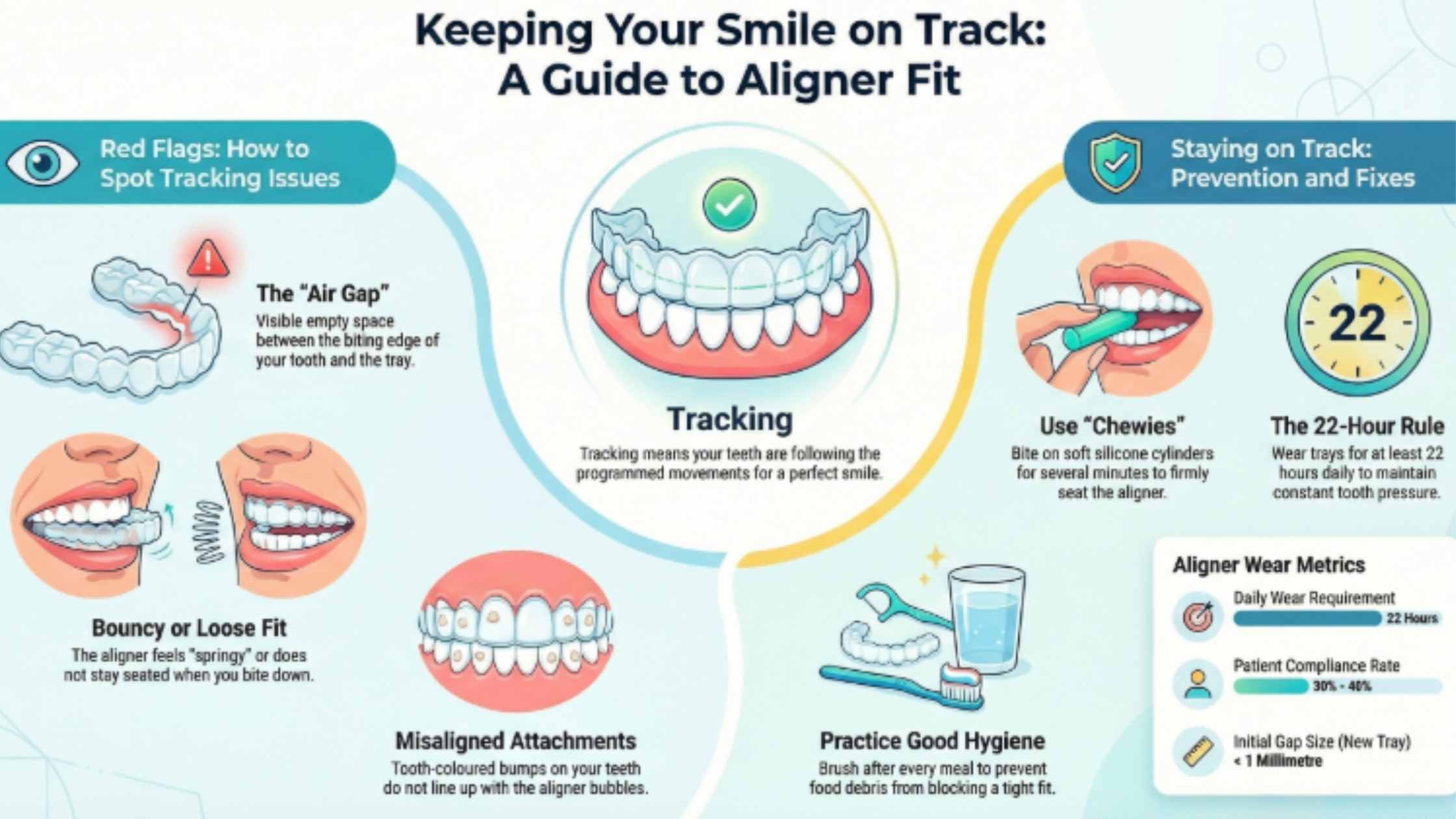
Tracking refers to how well your teeth “follow” the shape of the aligner.
Think of your clear aligners like a GPS for your teeth. A digital map is made by your dentist or orthodontist. This map will tell you precisely where you have your teeth now and where they must go. Every new tray is a stop on that map.
When they move exactly how the plastic tray wants them to, we say that the teeth are tracking.
But aligner tracking issues happen when the teeth and the tray stop moving together. It is like the GPS tells you to turn left, but your teeth keep going straight. When this issue occurs, the aligners are not able to do their job effectively any longer.
This is like wearing a glove. When the glove is a perfect fit, your fingers reach to the ends. When the glove is tight, or you are not pushing your hand into the end, then there is a space at the fingertips. In the world of teeth, that space is a sign that you have aligner fit issues.
How to Spot Aligner Tracking Issues
It is very important to check your fit every day. If you identify an issue early, it is easy for your orthodontist to fix it.
The following are the most frequent signs that your teeth are not tracking in the right way.
The “Air Gap”:
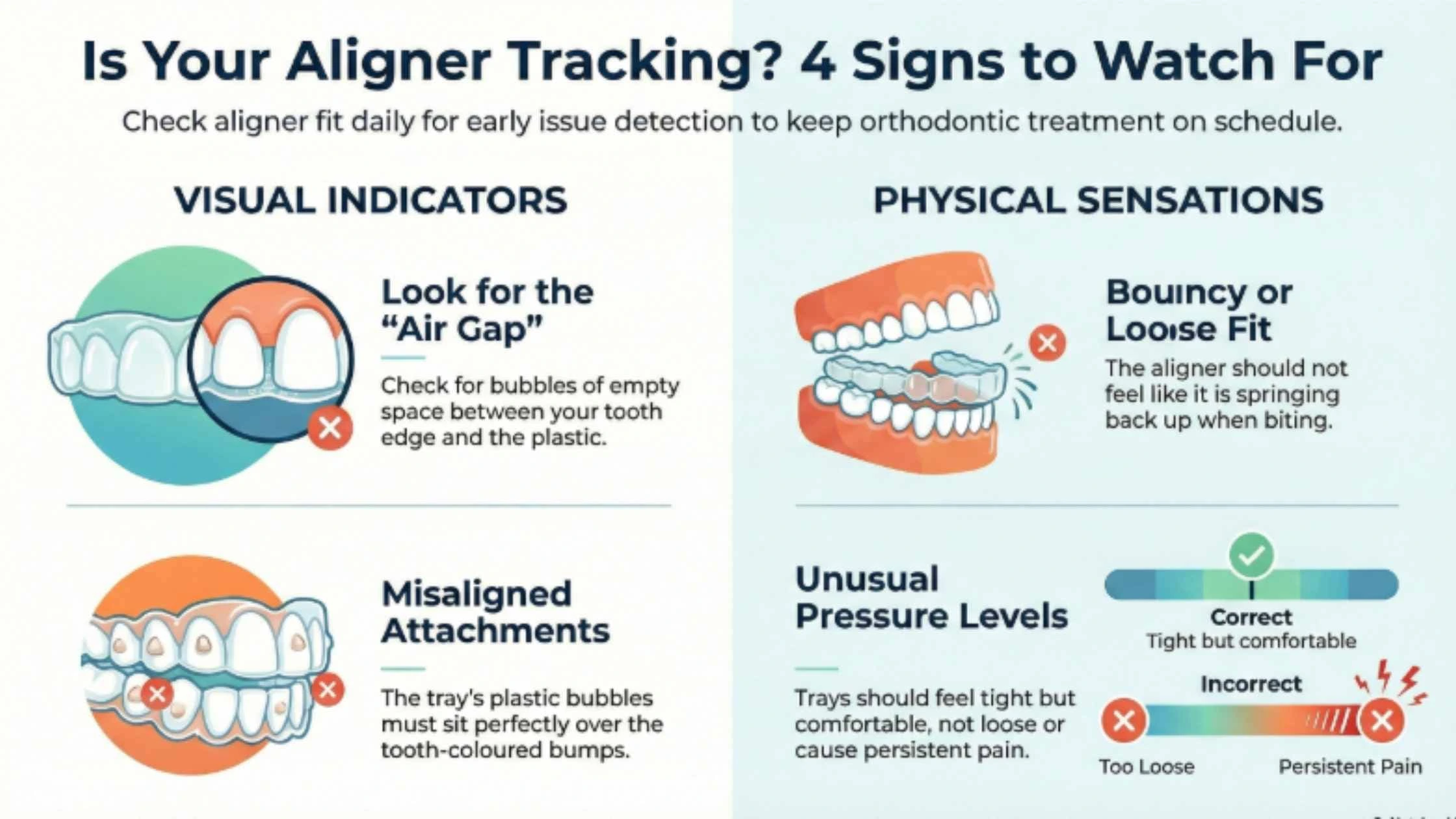
Have a close look at the biting edge of your teeth. Do you see any gap between the top of your tooth and the plastic of the aligner? When you find that there is a bubble of space, your tooth is not fully placed in the tray.
A Loose Fit:
Does the aligner feel bouncy? When you bite down, does it feel like it is springing back up? This is a major sign of aligner fit issues.
Attachments Not Lining Up:
Sometimes, small, tooth-coloured bumps called attachments are glued to the teeth. They work like door handles for the aligners. If the little “bubble” in the plastic tray isn’t sitting right over the bump on your tooth, you have a tracking problem.
Persistent Pain (or No Pressure at All):
Although a new tray is supposed to be tight, it should feel comfortable. In case a tray seems wrong or loose after a week, it may not be tracking.
Why Do Aligner Tracking Issues Happen?
You might be wondering, “I’m wearing aligners, so why aren’t they working?” There are several reasons why aligner tracking Issues occur. Some are things you can control, and some are just about how your body works.
The 22-Hour Rule
Not wearing aligners for the prescribed duration is the most common cause of tracking issues. Keep in mind that your teeth should be constantly pressured. According to one report, only 30-40% of patients wear aligners for the recommended duration, which is 22 hours.
If you leave your aligners out for long lunches or forget to put them back in at night, your teeth will begin to shift back to the old positions.
Stubborn Teeth
Everyone’s body is different. Some people have soft bones, which allows teeth to move fast. Others have very thick bone or tooth root stubbornness. It may happen that a certain tooth (such as a lateral incisor or a canine) will just not move as quickly as the computer estimated. This is a biological reason behind aligner tracking issues.
“Diving” or Tilted Teeth
There are cases when a tooth has to move in a complicated manner, such as rotating or moving up into the gum. In case the aligner does not take a good hold on the tooth, the tooth may tilt rather than move physically. This leaves a gap in the tray, causing aligner fit issues.
Poor “Seating”
You cannot simply push your aligners with your fingers and hope for the right results. Unless they are pushed all the way down (seated), the pressure won’t occur in the right place. Over a few days, this small gap becomes a big gap.
How to Prevent and Fix Tracking Problems
If you notice a gap, don’t panic! Most of the time, you can get things back on track without needing a whole new set of trays.
Use “Chewies”
Chewies are cylindrical, tiny, and made of soft plastic or silicone. They resemble an earplug or foam. When you insert your aligners, you bite the chewie for a few minutes. Chewing a chewie makes the aligner cling around the tooth. This seals these small air holes and makes sure that the tray is applying the appropriate level of force.
Practice Good Hygiene
The aligner will not fit tightly if there is food or tartar on your teeth. In the same way, your trays need to be clean; they can either warp or collect debris.
- Brush after every meal.
- Wash your trays with cold water (hot water may melt the plastic!).
- Make sure that you do not have anything between your tooth and the tray. A small food particle will create aligner fit problems.
Backtrack (With Doctor’s Permission)
Sometimes, your doctor might tell you to wear your previous tray for an extra week. This gives your “stubborn” teeth a little more time to catch up before moving to the next step. But never do this without asking your dentist first!
When to Call Your Doctor
It is normal to have a tiny gap (less than a millimetre) when you first put in a brand-new tray. Usually, that gap disappears after a day or two of wearing it.
However, you should call your dental office if:
- The gap is getting bigger over time.
- The aligner is extremely painful or cuts into your gums.
- You have finished your week of wear, and the tray still doesn’t fit properly.
- An attachment (those little bumps) has fallen off.
Not taking care of aligner tracking issues can lead to refinements. In this process, the dentist has to reassess your teeth and create a whole new set of trays. This can extend your treatment time. Therefore, it is always better to take care of a small fit issue today than a big, costly movement problem next month.
Final Thoughts
Clear aligners are an advanced technology to straighten your teeth. But they require your contribution too to show results. Take care of them by coordinating with your dentist over any issues and following the guidelines. It helps you stay in control of your treatment.