

When it comes to getting a straighter smile, most people just think about the result—perfectly aligned teeth with a confident grin.
But for an orthodontist, there are a lot of factors to be considered to make the journey right for a patient from “before” to “after”. It is a well-planned, meticulous dance of biology and engineering. The core of aligner treatment planning lies in a concept called staging.
Staging is the roadmap that tells each tooth exactly when to move, how far to go, and when to stay still. To help you understand this crucial element of modern aligner therapy, we have come up with this blog. Let’s get started.
What is Staging in Aligner Treatment Planning?
Staging is simply the way orthodontists divide the movement of teeth into small, manageable steps. The teeth are not moved all at once. Instead, the entire movement is divided into stages. Each stage starts with a new aligner.
Think of staging like climbing a set of stairs instead of trying to jump to the top in one leap. Each step is a small step, and taken together, all these steps will bring your teeth to the desired position.
During those steps, it is determined how much each tooth should move with each aligner and in which sequence the movement should happen. The aligners put some mild forces on the teeth to move them in small steps. Clinicians can make sure that the forces are safe, effective, and biologically sound by planning and sequencing these stages carefully.
Why Staging Matters
Staging plays a key role in the process of aligner treatment planning because of the following reasons:
It Regulates the Force on Teeth
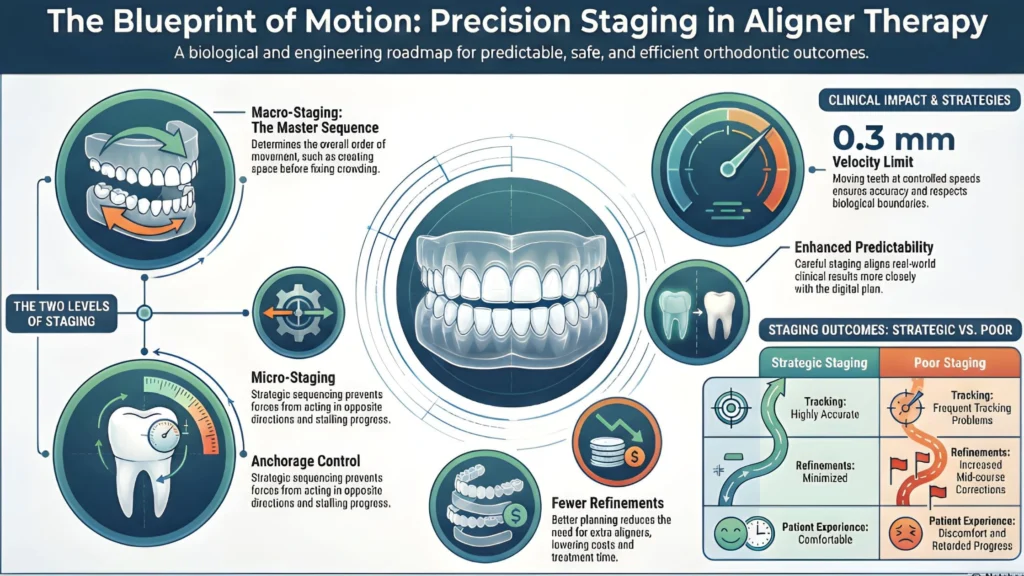
Teeth cannot be pushed too far or too fast. The movement happens at a natural speed biologically. Excessive staging (excess movement per aligner) may result in tracking problems, retarded progress, or even discomfort.
Studies have proved that smaller steps make the actual tooth movement closer to the digital plan. For example, in rotational movements (like turning a tooth), smaller movements per aligner were found to be more accurate than larger jumps.
It Improves Predictability
Predictability means how well the planned movements match the real results in the mouth. Good staging helps aligners to do precisely what they are supposed to do. Lack of proper staging may lead to delays, unforeseen outcomes or additional refinements.
A 2019 study has found that the more careful the staging, the closer the clinical outcomes are to what was planned digitally. In one clinical comparison, the actual position of teeth at different stages of treatment was not equal to the predicted digital models, which shows that the planning and staging still requires fine-tuning to achieve better results.
It Reduces Refinements
Refinements are additional aligners needed when the initial stages don’t achieve the planned outcome.
Improved staging will result in fewer surprises and fewer additional aligners. It is beneficial to both patients and clinicians, as it can lower costs as well as reduce the total treatment time.
The Staging: Macro-Staging and Micro-Staging.
Staging has two levels, which are macro and micro.
Macro-Staging
Macro-staging looks at the overall sequence of tooth movements. It decides which big step happens first. For example, an orthodontist may decide if they have to open space before realigning the front teeth, or they need to get molars back and then fix the crowding in the front.
Macro-staging helps control the anchorage of some teeth being used as support when the others are being moved. Unless these general steps are strategised in the correct sequence, forces may act in opposite directions and stall progress.
Micro-Staging
Micro-staging deals with minute movements of individual teeth, such as the degree of rotation or slight changes of position. It considers the details of each aligner’s impact.
Studies on rotational movements, such as those involving rotational movements of about 1.5 degrees per aligner, show that rotational movements of a smaller magnitude compared to larger movements per step are more accurate.
Macro and micro-staging allow orthodontists to create aligner treatment plans that incorporate both general objectives and precise adjustments.
Common Staging Strategies in Aligner Planning
The following are some of the strategies that clinicians apply in practice:
Sequential Movement
Some groups are not moved at the same time as all the teeth. As an example, back teeth can move slightly to allow front teeth to make space before the latter can start making bigger moves. The strategy enhances control of anchorage and minimises undesired movement.
Controlled Interproximal Reduction (IPR)
Sometimes a little space is created by gently stripping enamel between teeth (IPR). It is staged at certain treatment phases to help teeth move more predictably.
Attachment Timing
Small attachments help aligners hold teeth and apply forces. Deciding when to place attachments is part of staging and affects how well each tooth moves.
Velocity of Movement
Most aligner systems are designed to move teeth to a certain degree with each aligner, such as 0.3 mm. When this movement is slowed down, the teeth often move more accurately, especially in cases that involve complex or difficult corrections.
The Role of Staging in the Comprehensive Planning of Aligner Treatment.
Aligner treatment planning, staging, etc., is not all about making the teeth straight. It also addresses factors like how the bones, gums, and teeth of the patient will react to gentle forces in the long run. An effective plan accounts for biological boundaries, patient variations and the movement of each tooth in a distinct manner.
The entire process is also made predictable through good staging. That not only impacts the clinical success, but also aligns with patient comfort and satisfaction.
Effective staging supports:
- More precise movements of teeth
- Fewer surprises in the process of treatment
- Fewer mid-course corrections
- Reduced the total time of treatment
- Better long-term stability
The Conclusion
Aligner treatment planning is where science meets art.
Careful staging of teeth alignment treatment helps clinicians achieve results for their patients with convenience, accuracy, and safety. That’s why it is more than just creating a tray.